
ProvenanceClassificationDestinationsRetention
AGENTGUARD ENTERPRISE
Control the full agent runtime.
Control risk before and after LLM and tool execution with sanitization, degradation, approval, or denial.
PROTECTED OBJECTSCover the complete context of agent action
- Agents and subagents
- Identity and delegation
- Data and memory
- Tools and MCP
- External action and production systems
ENTERPRISEAgentGuard Enterprise
OPEN SOURCEAgentGuard Community
FRAMEWORKS
 LangChain
 Microsoft AutoGen
 OpenAI Agents SDK
 LangGraph
 LlamaIndex
 Dify
Dify OpenClaw
CONTROL POINTSLLM · Tool · Memory
DEPLOYMENTInside the enterprise boundary
SYSTEM-WIDE PROPAGATION
See risk move through the agent system
AgentGuard binds data, authorization, and action effect to the complete execution trace
AGAgentGuardAgentGuard Interaction Boundary Runtime
Node inspection view●Data■Action effect
UNIFIED SECURITY INFLUENCE ENGINE
Control behavior, reasoning, and data chains
Understand action composition, task intent, and data propagation together at every interaction boundary
PrincipalCapabilityScopeDelegation and expiry
ReadCreateModifyExecuteCommit
AgentGuardUnified Security
Influence EngineContextual joint evaluation
Influence EngineContextual joint evaluation
Minimum necessary control
ALLOWREDACTRECHECKSANDBOXAPPROVALDENY
Task intent · Propagation lineage · Target boundary · Policy constraints
Risk emerges from the combination of three flows, not one label
Produce an explainable allow, repair, recheck, sandbox, approval, or denial
View technical evidence
Task intent, propagation lineage, target boundary, and policy constraints are evaluated in one boundary state
DIRECT · SEMANTIC · CONTEXTUAL · DECLASSIFICATIONRUNTIME SECURITY CONTROL
Intervene before risk becomes impact
Simulate real tasks and see how AgentGuard preserves business capability while controlling high-impact action
AGAgentGuardRuntime Intervention Simulator
Deterministic simulationBusiness taskGenerate a renewal analysis and send a management brief to an approved adviserExecution path · CRM → Contract data → LLM → Report → External adviser
AgentGuard Interaction Boundary Runtime
●Data■Action effect
COMMUNITY PRODUCT SURFACES
From policy to audit.
See runtime traffic, policy configuration, approval, and audit. Enterprise adds deployment and integration support.
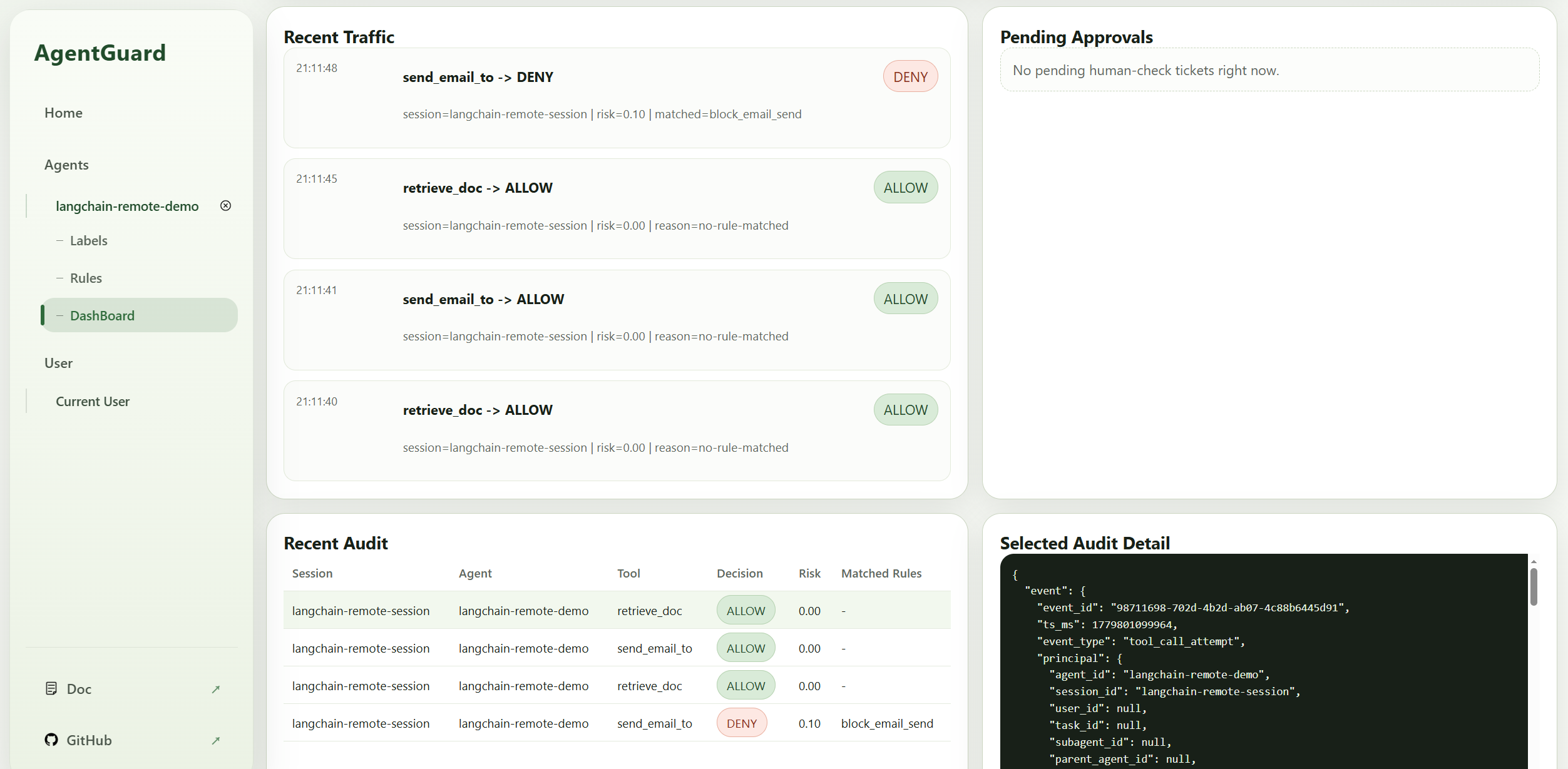
Community Edition interface
View original ↗Runtime traffic and decisions
Inspect tool calls, policy matches, and decisions by session.
Community Edition interface
View original ↗Approvals, rules, and raw events
Connect pending approvals, matched rules, and traceable event details.
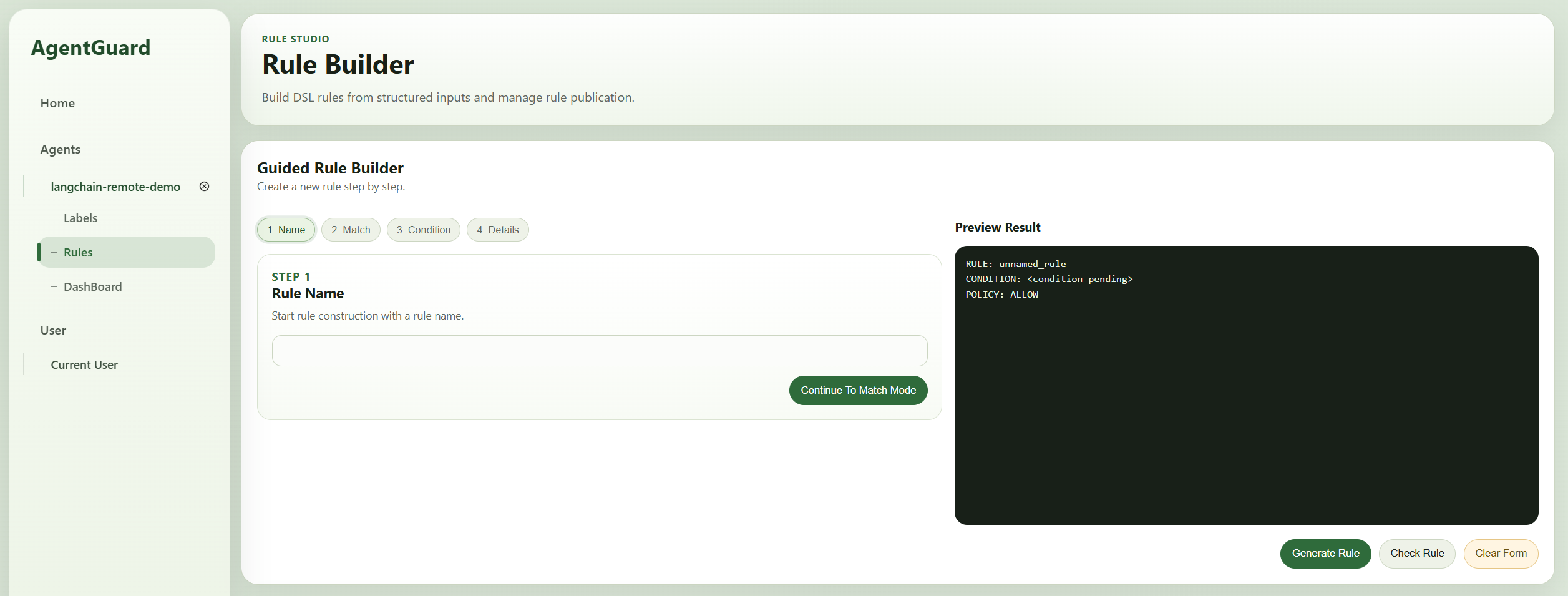
Community Edition interface
View original ↗Structured policy configuration
Configure conditions through guided controls while previewing the DSL.
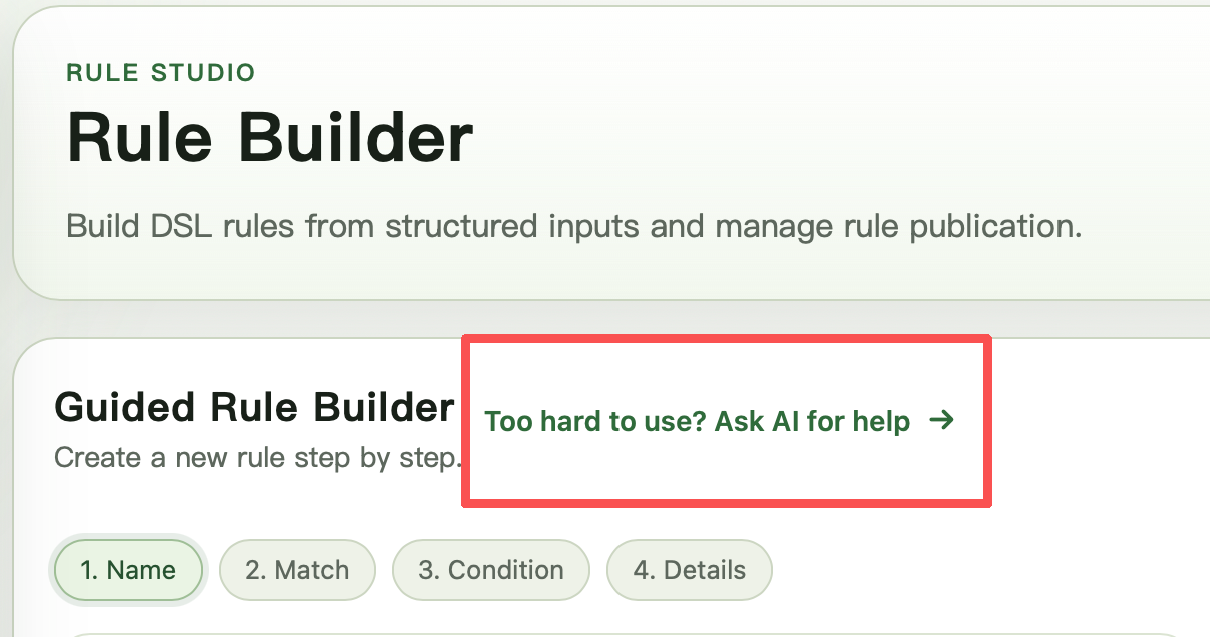
Community Edition interface
View original ↗Generate policy from security intent
Convert natural-language security intent into reviewable policy.
Community Edition interface
Complete Community workflow
Follow runtime monitoring, policy configuration, and audit.
- 01Retrieve the confidential document.
- 02Retain cross-tool context.
- 03Check recipient, document, and trust.
- 04Allow the admin path; deny the other path.
EDITIONS
One foundation. Two ways to deploy.
Community provides the open runtime-security foundation. Enterprise supports organization-wide deployment and continuous security operations.
AgentGuard Community
A self-managed edition for developers and researchers.
- Public framework adapters
- Four runtime hooks
- DSL policy rules
- Visual configuration
- Runtime audit
- Plugin extensions
AgentGuard Enterprise
For organization-wide deployment, integration, and continuous security operations.
- Private deployment support
- Central policy and audit integration
- Custom adapters
- Custom policies and safety models
- Continuous validation and technical support
INTEGRATION & DEPLOYMENT
Enforce inside the trust boundary.
Connect through hooks, sidecars, or gateways. Keep policy and evidence private.
01Agent frameworks→
02SDK · Sidecar · Gateway→
AGAgentGuard Runtime→
04Models · Tools · MCP · Data→
05Private Control Plane
Application embedded
Hooks preserve full runtime context.
Infrastructure enforced
Gateways centralize tool and data control.
Privately operated
Keep policy, traces, and evidence private.
WORKS WITH YOUR SECURITY STACK
Add agent-aware runtime context
AgentGuard complements existing security systems with context for the full agent action
IAMStatic identity and permissionsTask context, delegation chain, and one-time grants
DLPContent and egress channelsDerived-data lineage and multi-step propagation
API GatewayIndividual requestsThe model, tool, and task trace before each request
SIEMEvents and logsDecision evidence, payload change, and business outcome
VERIFIABLE EVIDENCE
Code, models, research.
Set a control boundary for agent runtime.
Assess the stack, critical permissions, and deployment constraints.
- Map one real agent workflow
- Mark identity, data, and action boundaries
- Simulate privilege, egress, or high-impact risk
- Review AgentGuard response and audit evidence
- Discuss integration and private deployment