 NUWA
Evaluation dossier
Measuring AI Agents’ Progress on Multi-Step Cyber Attack Scenarios
Assesses autonomous progress through multi-step cyber scenarios.
Task and measurement
Benchmark protocol profile
- Task / subject
- Agents in two purpose-built cyber ranges
- Measurement target
- Task progress in two defined ranges under varied inference budgets.
- Interpretation boundary
- A purpose-built study is not an open-ended estimate of real-world cyber attack success.
Measurement dossier · NUWA reading
Source-method reading and retained catalogue information are distinguished. Publication does not establish independent evidence or bilingual editorial review.
- Measurement construct
- How do model generations and inference budgets affect progress on linked cyber-range tasks?
- Task population
- Seven models are tested on two purpose-built ranges with 32 and 7 steps; the recent-model 100M-token end-to-end conditions have five attempts each.
- Scoring and failure modes
- Number of range steps completed; best-run and mean progress differ.
- System conditions
- 10M versus 100M-token conditions; recent high-budget end-to-end cells have five attempts.
- Statistical meaning
- Source-reported result statements; this does not establish trial counts, denominators or an estimator: At 10M tokens, mean corporate-range progress rose from 1.7 steps for GPT-4o to 9.8 for Opus 4.6. The best reported run completed 22/32 steps; this is not the average completion rate.
- Validity and interpretation
- Two bespoke ranges and small high-budget samples limit generalization; publication can reduce future held-out validity (§5).
- Appropriate research use
- Model recommendation: compare matched token budgets and report run variance alongside best-run progress.
- Measuring AI Agents’ Progress on Multi-Step Cyber Attack Scenarios · AbstractSelected original resource https://arxiv.org/html/2603.11214; sha256:fe735767bb4d07e484ce73b74b4095cb5dda946262a39b0fd70c3ed2f05015cf; archived source capture; exact capture time not independently established
- Measuring AI Agents’ Progress on Multi-Step Cyber Attack Scenarios · §3.3 Experimental designSelected original resource https://arxiv.org/html/2603.11214; sha256:fe735767bb4d07e484ce73b74b4095cb5dda946262a39b0fd70c3ed2f05015cf; archived source capture; exact capture time not independently established
- Measuring AI Agents’ Progress on Multi-Step Cyber Attack Scenarios · §2 ResultsSelected original resource https://arxiv.org/html/2603.11214; sha256:fe735767bb4d07e484ce73b74b4095cb5dda946262a39b0fd70c3ed2f05015cf; archived source capture; exact capture time not independently established
- Measuring AI Agents’ Progress on Multi-Step Cyber Attack Scenarios · §5 LimitationsSelected original resource https://arxiv.org/html/2603.11214; sha256:fe735767bb4d07e484ce73b74b4095cb5dda946262a39b0fd70c3ed2f05015cf; archived source capture; exact capture time not independently established
Original source charts and materials
Related research questions
Cybersecurity / Cyber task execution →
Task completion in a bounded range measures capability under its specific protocol.
References
- [1] Linus Folkerts, Will Payne, et al.. Measuring AI Agents’ Progress on Multi-Step Cyber Attack Scenarios. Research page checked 2026-10-25 ; Official publication masthead and article byline
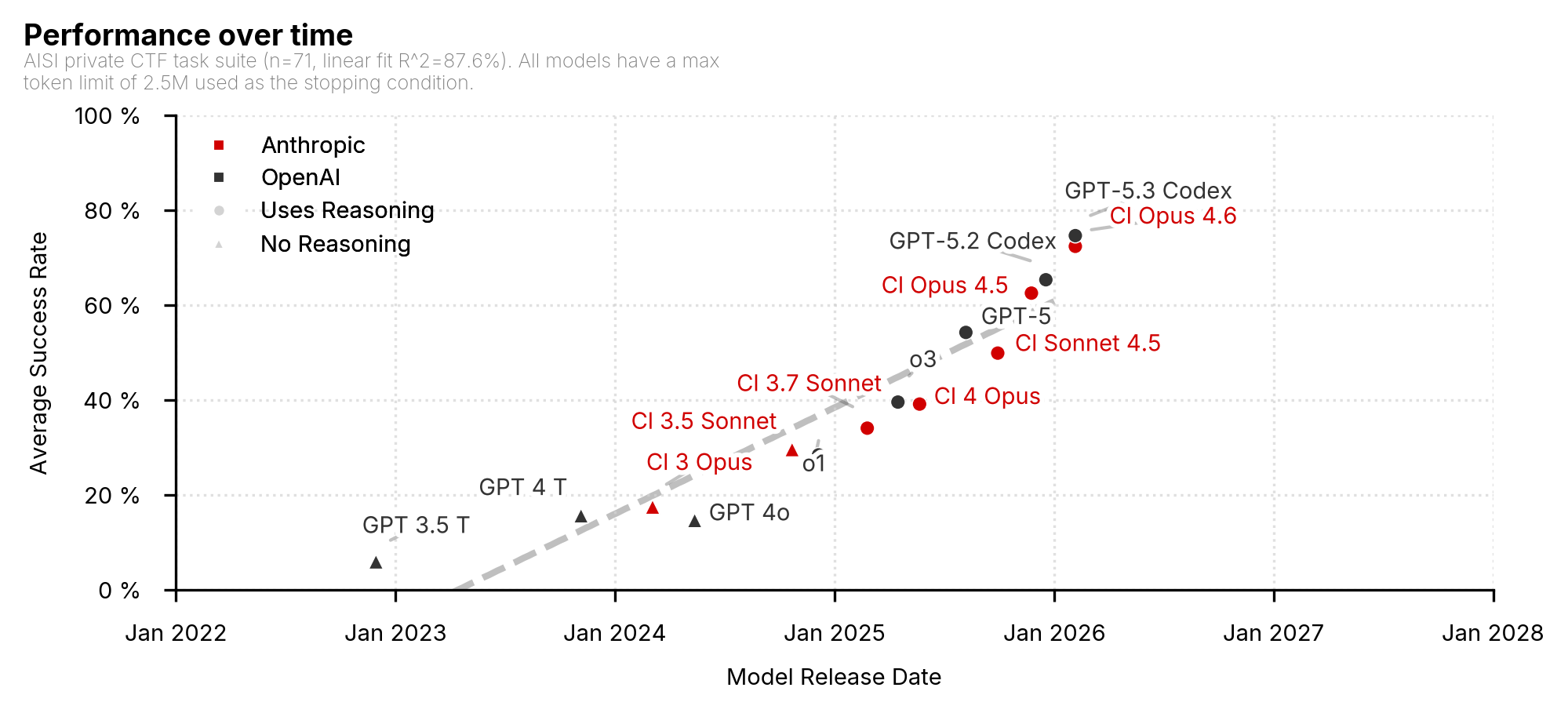
- [2] Linus Folkerts, Will Payne, et al.. Measuring AI Agents’ Progress on Multi-Step Cyber Attack Scenarios ; Figure 7