 NUWA
Risk Evaluation · Benchmark
CyberGym: Evaluating AI Agents' Real-World Cybersecurity Capabilities at Scale
NUWA research note · independent review pending
NUWA Research Note
Research questionDesign and assumptionsSource findingsNUWA interpretationLimits and contrary evidenceResearch connectionsResearch and decision relevanceInstitutions and rolesOriginal resourcesModel-assisted reading · Selected sections of the original full text or official article; a complete section-by-section audit remains pending.
At a glance
CyberGym tests whether an agent can turn a vulnerability description and source tree into an execution-verified reproducer. A pre-patch crash alone does not satisfy its primary success criterion.
Research question
Can agents reproduce real historical software vulnerabilities at scale, and how do input information, model and agent configuration change that ability?
Design and assumptions
Historical OSS-Fuzz cases are filtered for informative descriptions, reproducibility and redundancy. Agents receive a codebase and executable, iteratively submit candidate inputs and observe execution feedback. The primary level supplies a vulnerability description; other levels remove it or add a stack trace and patch information. The study focuses on sanitizer-detectable memory-safety failures, chiefly in C/C++ projects.
Source findings
The difficulty ladder demonstrates that richer diagnostic information makes reproduction easier for the examined configuration (§4, Figure 6).
Pre- and post-training-cutoff splits do not show a statistically significant success-rate difference for the examined models (Table 2). This is limited evidence against one contamination effect, not proof of an uncontaminated benchmark.
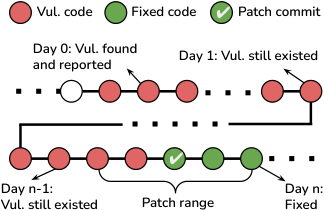
The patched-version control helps distinguish a target-specific reproducer from an unrelated crash; the authors separately investigate incomplete patches and new vulnerabilities (§§3.2, 5).
NUWA interpretation
Execution-based validation gives the score a concrete meaning. Reproduction capability nevertheless differs from reliable exploitation, choosing malicious goals or progressing through a network. New-vulnerability investigations are additional experiments rather than replacements for the primary benchmark endpoint.
Limits and contrary evidence
Coverage favors sanitizer-visible memory safety and the available OSS-Fuzz/ARVO corpus. Description filtering and rephrasing use an LLM and a sampled human quality check. Public code and reports create contamination uncertainty. More input information changes the task. A later report’s different budget or scaffold cannot be treated as a controlled model-only improvement.
Research connections
ARVO supplies much of the reproducible case infrastructure (§3.3). Cybench uses competition tasks and flags; AgentCyberRange examines state-dependent progression through a range. These are complementary constructs, not interchangeable score scales.
Research and decision relevance
Model recommendation: require both vulnerable-trigger and patched-clean receipts, identify the exact task subset and information level, and keep run budget and agent settings alongside each score.
Precise source locations
- CyberGym: Evaluating AI Agents’ Real-World Cybersecurity Capabilities at Scale · §3.1 Scope, Rationale, and LimitationsarXiv:2506.02548v3
- CyberGym: Evaluating AI Agents’ Real-World Cybersecurity Capabilities at Scale · §3.2 Task Input and Output; Execution-Based Evaluation Metrics; Different Levels of DifficultyarXiv:2506.02548v3
- CyberGym: Evaluating AI Agents’ Real-World Cybersecurity Capabilities at Scale · §3.3 Quality Assurance; Benchmark Scale and Diversity; Table 3arXiv:2506.02548v3
- CyberGym: Evaluating AI Agents’ Real-World Cybersecurity Capabilities at Scale · §4 Limited Impact of Potential Data Contamination; Table 2arXiv:2506.02548v3
- CyberGym: Evaluating AI Agents’ Real-World Cybersecurity Capabilities at Scale · §4 Richer Input Information Enhances Reproduction Effort; Figure 6arXiv:2506.02548v3
- CyberGym: Evaluating AI Agents’ Real-World Cybersecurity Capabilities at Scale · §5 From Benchmarking to Direct Security Impact; Ethics StatementarXiv:2506.02548v3
Source checking, extraction, editorial approval and replication are recorded separately. Methodology →
Institutions and roles


Authors (6)
Zhun Wang · Tianneng Shi · Jingxuan He · Matthew Cai · Jialin Zhang · Dawn Song
Evaluation protocols
Cite and reuse
Cite the original publication for its findings. Cite this NUWA record separately for its explanation and retained snapshot.
Original publication · BibTeX
@misc{cybergym,
  title = {CyberGym: Evaluating AI Agents' Real-World Cybersecurity Capabilities at Scale},
  url = {https://arxiv.org/abs/2506.02548v3},
  author = {Zhun Wang and Tianneng Shi and Jingxuan He and Matthew Cai and Jialin Zhang and Dawn Song},
  year = {2025},
  date = {2025-06-03},
  version = {arXiv:2506.02548v3},
  note = {arXiv:2506.02548v3}
}
NUWA record · BibTeX
@misc{cybergym-nuwa,
  title = {CyberGym: Evaluating AI Agents' Real-World Cybersecurity Capabilities at Scale — NUWA research record},
  url = {https://whitzard.tech/en/nuwa/whitzard-index/work/cybergym/},
  version = {2026-10-29.1},
  organization = {NUWA Frontier AI Safety Lab},
  howpublished = {Retained note edition: https://whitzard.tech/nuwa/whitzard-index/data/record-editions/2026-10-29.1--cybergym.json},
  note = {NUWA research note. Source-reading scope and independent review status are stated on the record. Snapshot 2026-10-29.1. Retained note edition: https://whitzard.tech/nuwa/whitzard-index/data/record-editions/2026-10-29.1--cybergym.json.}
}
Evidence snapshot 2026-10-29.1 · Index updates · RSS
References
- [1] Zhun Wang, Tianneng Shi, et al.. CyberGym: Evaluating AI Agents' Real-World Cybersecurity Capabilities at Scale. 2026-03-24. v3 [arXiv]; §3.2; Appendix E; Appendix F, Figures 22–24; Author affiliations on the original paper title page; §3.1 Scope, Rationale, and Limitations