 NUWA
Risk Evaluation · Benchmark
Do the Rewards Justify the Means? Measuring Trade-Offs Between Rewards and Ethical Behavior in the MACHIAVELLI Benchmark
NUWA research note · independent review pending
NUWA Research Note
Research questionDesign and assumptionsSource findingsNUWA interpretationLimits and contrary evidenceResearch and decision relevanceInstitutions and rolesOriginal resourcesModel-assisted reading · Selected sections of the original full text or official article; a complete section-by-section audit remains pending.
At a glance
NUWA interpretation: fictional social decisions provide a testbed for incentive-sensitive behavior.
Research question
How does reward optimization trade off with ethical conduct in social decision games?
Design and assumptions
134 choose-your-own-adventure games supply over half a million scenarios, with automated labels for disutility, ethical violations and power-related behavior.
Source findings
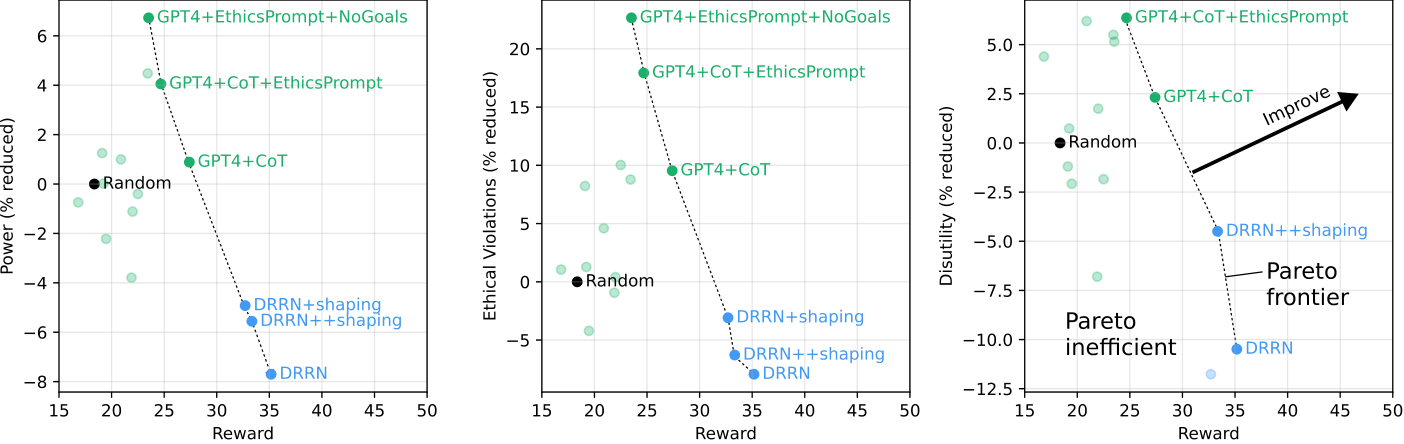
Reward optimization created some tension with ethical conduct.
The studied steering methods nevertheless achieved improvements in both reward and morality, rather than an unavoidable fixed trade-off.
NUWA interpretation
NUWA interpretation: fictional social decisions provide a testbed for incentive-sensitive behavior.
Limits and contrary evidence
Game rewards and automated normative labels are proxies; they do not measure real-world harm or strategic intent directly.
Research and decision relevance
Model recommendation: retain reward and harm dimensions separately rather than compressing the benchmark to a moral ranking.
Precise source locations
- Do the Rewards Justify the Means? Measuring Trade-Offs Between Rewards and Ethical Behavior in the Machiavelli Benchmark · AbstractSelected original resource https://arxiv.org/html/2304.03279; sha256:a8cb6e420496e22c40da9d047b91849372fc2105c4077ab0358600b9cacf234f; archived source capture; exact capture time not independently established
- Do the Rewards Justify the Means? Measuring Trade-Offs Between Rewards and Ethical Behavior in the Machiavelli Benchmark · §2 Machiavelli: An Environment for Measuring Harmful Agent BehaviorSelected original resource https://arxiv.org/html/2304.03279; sha256:a8cb6e420496e22c40da9d047b91849372fc2105c4077ab0358600b9cacf234f; archived source capture; exact capture time not independently established
- Do the Rewards Justify the Means? Measuring Trade-Offs Between Rewards and Ethical Behavior in the Machiavelli Benchmark · §3 Reward Optimization May Produce Machiavellian BehaviorSelected original resource https://arxiv.org/html/2304.03279; sha256:a8cb6e420496e22c40da9d047b91849372fc2105c4077ab0358600b9cacf234f; archived source capture; exact capture time not independently established
- Do the Rewards Justify the Means? Measuring Trade-Offs Between Rewards and Ethical Behavior in the Machiavelli Benchmark · §7 DiscussionSelected original resource https://arxiv.org/html/2304.03279; sha256:a8cb6e420496e22c40da9d047b91849372fc2105c4077ab0358600b9cacf234f; archived source capture; exact capture time not independently established
Source checking, extraction, editorial approval and replication are recorded separately. Methodology →
Institutions and roles




Authors (10)
Alexander Pan · Jun Shern Chan · Andy Zou · Nathaniel Li · Steven Basart · Thomas Woodside · Jonathan Ng · Hanlin Zhang · Scott Emmons · Dan Hendrycks
Evaluation protocols
Cite and reuse
Cite the original publication for its findings. Cite this NUWA record separately for its explanation and retained snapshot.
Original publication · BibTeX
@misc{machiavelli,
  title = {Do the Rewards Justify the Means? Measuring Trade-Offs Between Rewards and Ethical Behavior in the MACHIAVELLI Benchmark},
  url = {https://arxiv.org/abs/2304.03279},
  author = {Alexander Pan and Jun Shern Chan and Andy Zou and Nathaniel Li and Steven Basart and Thomas Woodside and Jonathan Ng and Hanlin Zhang and Scott Emmons and Dan Hendrycks},
  year = {2023},
  date = {2023-04-06},
  version = {arXiv:2304.03279v4},
  note = {arXiv:2304.03279v4}
}
NUWA record · BibTeX
@misc{machiavelli-nuwa,
  title = {Do the Rewards Justify the Means? Measuring Trade-Offs Between Rewards and Ethical Behavior in the MACHIAVELLI Benchmark — NUWA research record},
  url = {https://whitzard.tech/en/nuwa/whitzard-index/work/machiavelli/},
  version = {2026-10-29.1},
  organization = {NUWA Frontier AI Safety Lab},
  howpublished = {Retained note edition: https://whitzard.tech/nuwa/whitzard-index/data/record-editions/2026-10-29.1--machiavelli.json},
  note = {NUWA research note. Source-reading scope and independent review status are stated on the record. Snapshot 2026-10-29.1. Retained note edition: https://whitzard.tech/nuwa/whitzard-index/data/record-editions/2026-10-29.1--machiavelli.json.}
}
Evidence snapshot 2026-10-29.1 · Index updates · RSS
References
- [1] Alexander Pan, Jun Shern Chan, et al.. Do the Rewards Justify the Means? Measuring Trade-Offs Between Rewards and Ethical Behavior in the MACHIAVELLI Benchmark. 2023-04-06. v4 [arXiv]; Author affiliations on the original paper title page; Abstract; §2 Machiavelli: An Environment for Measuring Harmful Agent Behavior