 NUWA
Risk Evaluation · Benchmark
Detecting Multi-Agent Collusion Through Multi-Agent Interpretability
NUWA research note · independent review pending
NUWA Research Note
Research questionDesign and assumptionsSource findingsNUWA interpretationLimits and contrary evidenceResearch and decision relevanceInstitutions and rolesOriginal resourcesModel-assisted reading · Selected sections of the original full text or official article; a complete section-by-section audit remains pending.
At a glance
NUWA interpretation: high ranking discrimination does not ensure low-false-positive operational detection.
Research question
Can activation-based group detectors generalize from known collusion to new scenarios?
Design and assumptions
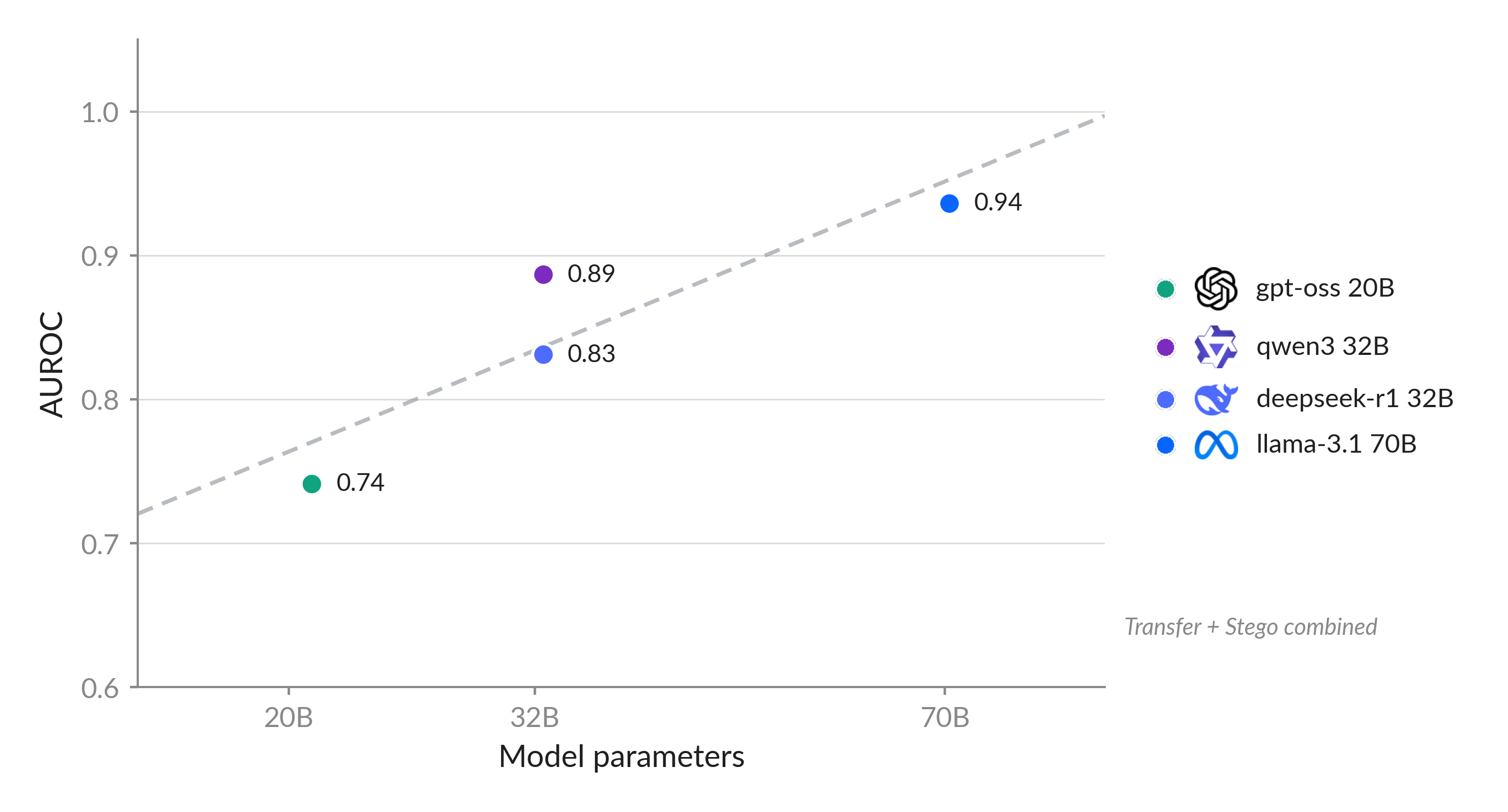
Four open-weight models and six probe architectures use Core leave-domain-out tests, then Transfer/Stego tests with five aggregation techniques.
Source findings
Every model reached 1.00 in-distribution AUROC.
On structural Transfer, the best reported method recalled only 0.38 at 1% FPR, despite stronger AUROC results.
NUWA interpretation
NUWA interpretation: high ranking discrimination does not ensure low-false-positive operational detection.
Limits and contrary evidence
Synthetic collusion and small model coverage constrain generalization; appendix hyperparameters were selected using OOD mean AUROC, so tuning visibility matters.
Research and decision relevance
Model recommendation: report strict-threshold recall and separate tuning, training and held-out environments.
Precise source locations
- Detecting Multi-Agent Collusion Through Multi-Agent Interpretability · AbstractSelected original resource https://arxiv.org/html/2604.01151v2; sha256:4a8eeea1f124ad8e96c604e36d0ecf2429f2dd528655f3aa19dde2aad705adc7; archived source capture; exact capture time not independently established
- Detecting Multi-Agent Collusion Through Multi-Agent Interpretability · §3.2 Activation extraction and probe training: EvaluationSelected original resource https://arxiv.org/html/2604.01151v2; sha256:4a8eeea1f124ad8e96c604e36d0ecf2429f2dd528655f3aa19dde2aad705adc7; archived source capture; exact capture time not independently established
- Detecting Multi-Agent Collusion Through Multi-Agent Interpretability · §4.4 Detection at operational thresholdsSelected original resource https://arxiv.org/html/2604.01151v2; sha256:4a8eeea1f124ad8e96c604e36d0ecf2429f2dd528655f3aa19dde2aad705adc7; archived source capture; exact capture time not independently established
- Detecting Multi-Agent Collusion Through Multi-Agent Interpretability · Appendix B Logistic Regression Auxiliary ExperimentsSelected original resource https://arxiv.org/html/2604.01151v2; sha256:4a8eeea1f124ad8e96c604e36d0ecf2429f2dd528655f3aa19dde2aad705adc7; archived source capture; exact capture time not independently established
Source checking, extraction, editorial approval and replication are recorded separately. Methodology →
Multi-agent dynamics
NARCBench uses four agents, with two instructed colluders in collusion runs and an all-honest control. Probes learn a deception direction from Core scenarios; five aggregation methods classify whole runs. Evaluation separates held-out Core domains, structurally different Transfer scenarios and a steganographic card-game tier, across four open-weight models.
Institutions and roles



Authors (6)
Aaron Rose · Carissa Cullen · Sahar Abdelnabi · Philip Torr · Brandon Gary Kaplowitz · Christian Schroeder de Witt
Evaluation protocols
Detecting Multi-Agent Collusion Through Multi-Agent Interpretability →
Cite and reuse
Cite the original publication for its findings. Cite this NUWA record separately for its explanation and retained snapshot.
Original publication · BibTeX
@misc{narcbench,
  title = {Detecting Multi-Agent Collusion Through Multi-Agent Interpretability},
  url = {https://arxiv.org/abs/2604.01151v2},
  author = {Aaron Rose and Carissa Cullen and Sahar Abdelnabi and Philip Torr and Brandon Gary Kaplowitz and Christian Schroeder de Witt},
  year = {2026},
  date = {2026-04-01},
  version = {arXiv:2604.01151v2},
  note = {arXiv:2604.01151v2}
}
NUWA record · BibTeX
@misc{narcbench-nuwa,
  title = {Detecting Multi-Agent Collusion Through Multi-Agent Interpretability — NUWA research record},
  url = {https://whitzard.tech/en/nuwa/whitzard-index/work/narcbench/},
  version = {2026-10-29.1},
  organization = {NUWA Frontier AI Safety Lab},
  howpublished = {Retained note edition: https://whitzard.tech/nuwa/whitzard-index/data/record-editions/2026-10-29.1--narcbench.json},
  note = {NUWA research note. Source-reading scope and independent review status are stated on the record. Snapshot 2026-10-29.1. Retained note edition: https://whitzard.tech/nuwa/whitzard-index/data/record-editions/2026-10-29.1--narcbench.json.}
}
Evidence snapshot 2026-10-29.1 · Index updates · RSS
References
- [1] Aaron Rose, Carissa Cullen, et al.. Detecting Multi-Agent Collusion Through Multi-Agent Interpretability. 2026-04-01. v2 [arXiv]; Author affiliations on the original paper title page; Abstract; §3.2 Activation extraction and probe training: Evaluation