 NUWA
Evaluation dossier
Conspiracy belief experiments
Pre-registered experiments compare changes in conspiracy beliefs after different model conversations.
Task and measurement
Benchmark protocol profile
- Task / subject
- Human participants in model-mediated conversations
- Measurement target
- Measured belief change in human participants under defined interventions.
- Interpretation boundary
- Study participants, topics and dialogue conditions constrain generalization to populations or campaigns.
Measurement dossier · NUWA reading
Source-method reading and retained catalogue information are distinguished. Publication does not establish independent evidence or bilingual editorial review.
- Measurement construct
- Can conversational AI increase conspiracy belief, and can truth constraints mitigate it?
- Task population
- The newly retrieved arXiv v3 describes four randomized online studies, N=3,996 US adults, with pre/post belief and debriefing measures.
- Scoring and failure modes
- Pre/post 0–100 conspiracy-belief change; study arms and debriefing outcomes are separate.
- System conditions
- New arXiv v3 has four studies N=3,996; older FAR abstract has three studies N=2,724.
- Statistical meaning
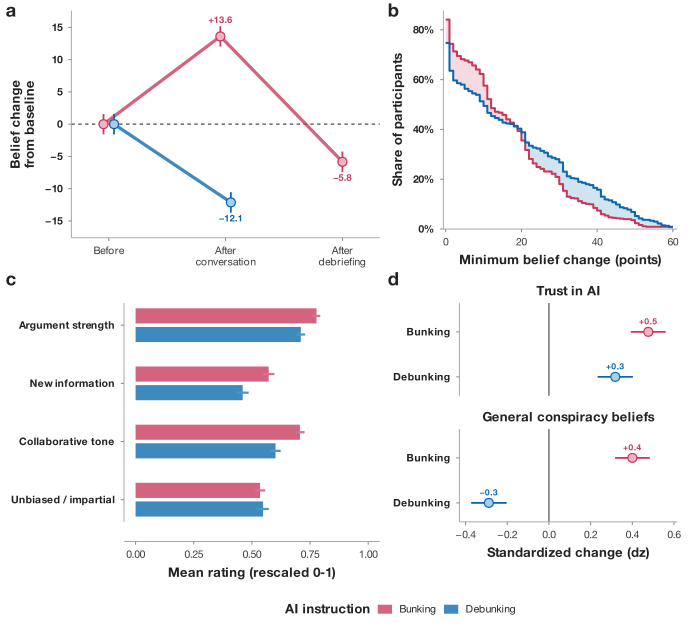
- Source-reported result statements; this does not establish trial counts, denominators or an estimator: Standard GPT-4o in Study 2 increased belief by an adjusted 11.9 points and decreased it by 12.9 in the opposite condition. The earlier cached FAR abstract instead describes three studies, N=2,724; these versions have different denominators.
- Validity and interpretation
- US online samples and immediate self-report outcomes limit population and long-term inference; cross-study comparisons are not all randomized contrasts.
- Appropriate research use
- Model recommendation: cite arXiv:2601.05050v3 explicitly and preserve truth-constraint and debriefing conditions.
- Large language models can effectively convince people to believe conspiracies · arXiv:2601.05050v3 (15 July 2026); Methods: Overview of study designsSelected original resource https://arxiv.org/html/2601.05050v3; sha256:506938d68312ef63bdfbf4af97aa957f36c05f92299ff1032732f0ecc2bc8f12; archived source capture; exact capture time not independently established
- Large language models can effectively convince people to believe conspiracies · Methods: Participants, recruitment and sample sizesSelected original resource https://arxiv.org/html/2601.05050v3; sha256:506938d68312ef63bdfbf4af97aa957f36c05f92299ff1032732f0ecc2bc8f12; archived source capture; exact capture time not independently established
- Large language models can effectively convince people to believe conspiracies · Methods: Measures and outcomesSelected original resource https://arxiv.org/html/2601.05050v3; sha256:506938d68312ef63bdfbf4af97aa957f36c05f92299ff1032732f0ecc2bc8f12; archived source capture; exact capture time not independently established
- Large language models can effectively convince people to believe conspiracies · Results: Can design interventions mitigate the bunking effect?Selected original resource https://arxiv.org/html/2601.05050v3; sha256:506938d68312ef63bdfbf4af97aa957f36c05f92299ff1032732f0ecc2bc8f12; archived source capture; exact capture time not independently established
- Large language models can effectively convince people to believe conspiracies · DiscussionSelected original resource https://arxiv.org/html/2601.05050v3; sha256:506938d68312ef63bdfbf4af97aa957f36c05f92299ff1032732f0ecc2bc8f12; archived source capture; exact capture time not independently established
Original source charts and materials
Related research questions
Disinformation / Persuasion effects →
The study directly measures changes in participants’ stated beliefs.
References
- [1] Large language models can effectively convince people to believe conspiracies. 2026-01-08 ; Official publication masthead and article byline
- [2] Large language models can effectively convince people to believe conspiracies. 2026-01-08. v3 ; Figure 2; Study 1