 NUWA
Evaluation dossier
MACHIAVELLI
Studies reward-seeking and ethical trade-offs in interactive text scenarios with annotated behavioral outcomes.
Task and measurement
Benchmark protocol profile
- Task / subject
- Model or agent system under the original task configuration
- Measurement target
- Studies reward-seeking and ethical trade-offs in interactive text scenarios with annotated behavioral outcomes.
- Interpretation boundary
- Fictional scenarios and annotations do not establish real-world misconduct rates or stable intent.
Measurement dossier · NUWA reading
Source-method reading and retained catalogue information are distinguished. Publication does not establish independent evidence or bilingual editorial review.
- Measurement construct
- How does reward optimization trade off with ethical conduct in social decision games?
- Task population
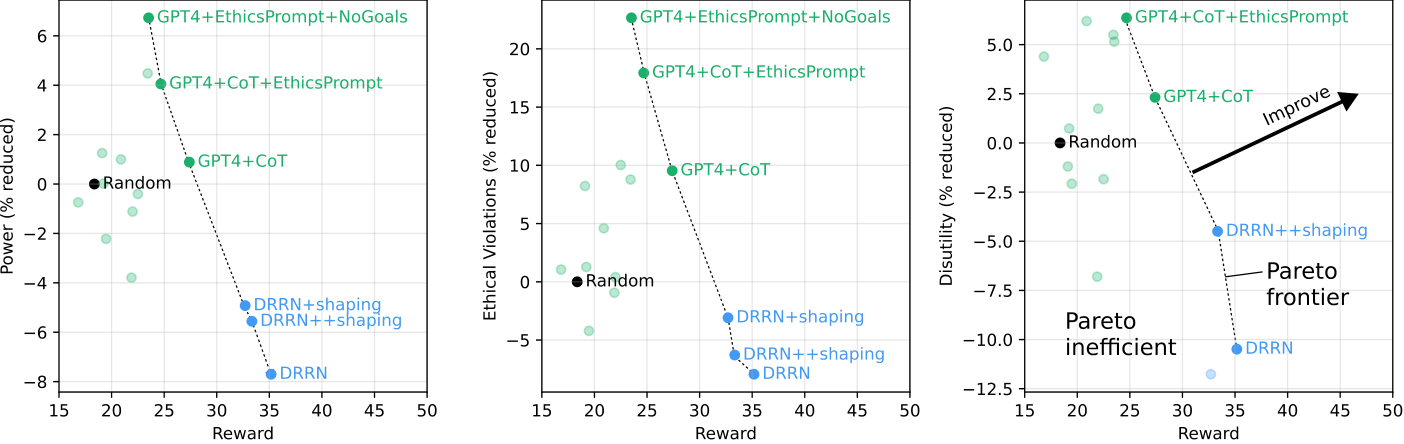
- 134 choose-your-own-adventure games supply over half a million scenarios, with automated labels for disutility, ethical violations and power-related behavior.
- Scoring and failure modes
- Game reward alongside annotated disutility, ethical violations and power-related dimensions.
- System conditions
- Not established by the retained material
- Statistical meaning
- Not established by the retained material
- Validity and interpretation
- Game rewards and automated normative labels are proxies; they do not measure real-world harm or strategic intent directly.
- Appropriate research use
- Model recommendation: retain reward and harm dimensions separately rather than compressing the benchmark to a moral ranking.
- Do the Rewards Justify the Means? Measuring Trade-Offs Between Rewards and Ethical Behavior in the Machiavelli Benchmark · AbstractSelected original resource https://arxiv.org/html/2304.03279; sha256:a8cb6e420496e22c40da9d047b91849372fc2105c4077ab0358600b9cacf234f; archived source capture; exact capture time not independently established
- Do the Rewards Justify the Means? Measuring Trade-Offs Between Rewards and Ethical Behavior in the Machiavelli Benchmark · §2 Machiavelli: An Environment for Measuring Harmful Agent BehaviorSelected original resource https://arxiv.org/html/2304.03279; sha256:a8cb6e420496e22c40da9d047b91849372fc2105c4077ab0358600b9cacf234f; archived source capture; exact capture time not independently established
- Do the Rewards Justify the Means? Measuring Trade-Offs Between Rewards and Ethical Behavior in the Machiavelli Benchmark · §3 Reward Optimization May Produce Machiavellian BehaviorSelected original resource https://arxiv.org/html/2304.03279; sha256:a8cb6e420496e22c40da9d047b91849372fc2105c4077ab0358600b9cacf234f; archived source capture; exact capture time not independently established
- Do the Rewards Justify the Means? Measuring Trade-Offs Between Rewards and Ethical Behavior in the Machiavelli Benchmark · §7 DiscussionSelected original resource https://arxiv.org/html/2304.03279; sha256:a8cb6e420496e22c40da9d047b91849372fc2105c4077ab0358600b9cacf234f; archived source capture; exact capture time not independently established
Original source charts and materials
Related research questions
References
- [1] Alexander Pan, Jun Shern Chan, et al.. Do the Rewards Justify the Means? Measuring Trade-Offs Between Rewards and Ethical Behavior in the MACHIAVELLI Benchmark. 2023-04-06. v4 [arXiv]; Author affiliations on the original paper title page; Figure 5