 NUWA
Evaluation dossier
MonitorBench: A Comprehensive Benchmark for Chain-of-Thought Monitorability in Large Language Models
Benchmarks chain-of-thought monitorability across tasks that include hidden objectives, underperformance and encoded communication.
Evidence update · 2026-10-28
Model-assisted reading · independent evidence and bilingual editorial review pending. Values are source findings or inventory counts, separate from the trend result series.
Separate recognition on fixed traces from safety diagnosis during execution. Self-assessment recall depends on its teacher labels; TraceProbe replay localises recorded actions rather than rerunning the model in a counterfactual.
Related reading
NUWA reading connections; these do not imply citation, replication or score equivalence.
Sources for this interpretation
- Scaling Misuse Detection with Self-Assessment · Results; limitations; text lines 00008,00014,00060Original resource captured 2026-10-28T07:24:41.534870+00:00; sha256:03b9ece6dae1c006622bb47373fb914bec20cee054a452748f30573c63ff6110
- TraceProbe: An Execution-Based Benchmark for Diagnosing Safety Failures in LLM Agents · §3.6; §5–6; Tables 2,15,17; limitations; text lines 00483Original resource captured 2026-10-28T07:24:41.534922+00:00; sha256:b0b85491f4be9fb842c2f97891b033a75b44a85c756b0f3b92cf8da775d8f828
Task and measurement
Benchmark protocol profile
- Task / subject
- Model or agent system in the original evaluation configuration
- Measurement target
- Benchmarks chain-of-thought monitorability across tasks that include hidden objectives, underperformance and encoded communication.
- Interpretation boundary
- Different task subsets and attacker constructions require separate interpretation; detecting an artifact is not unrestricted access to intent.
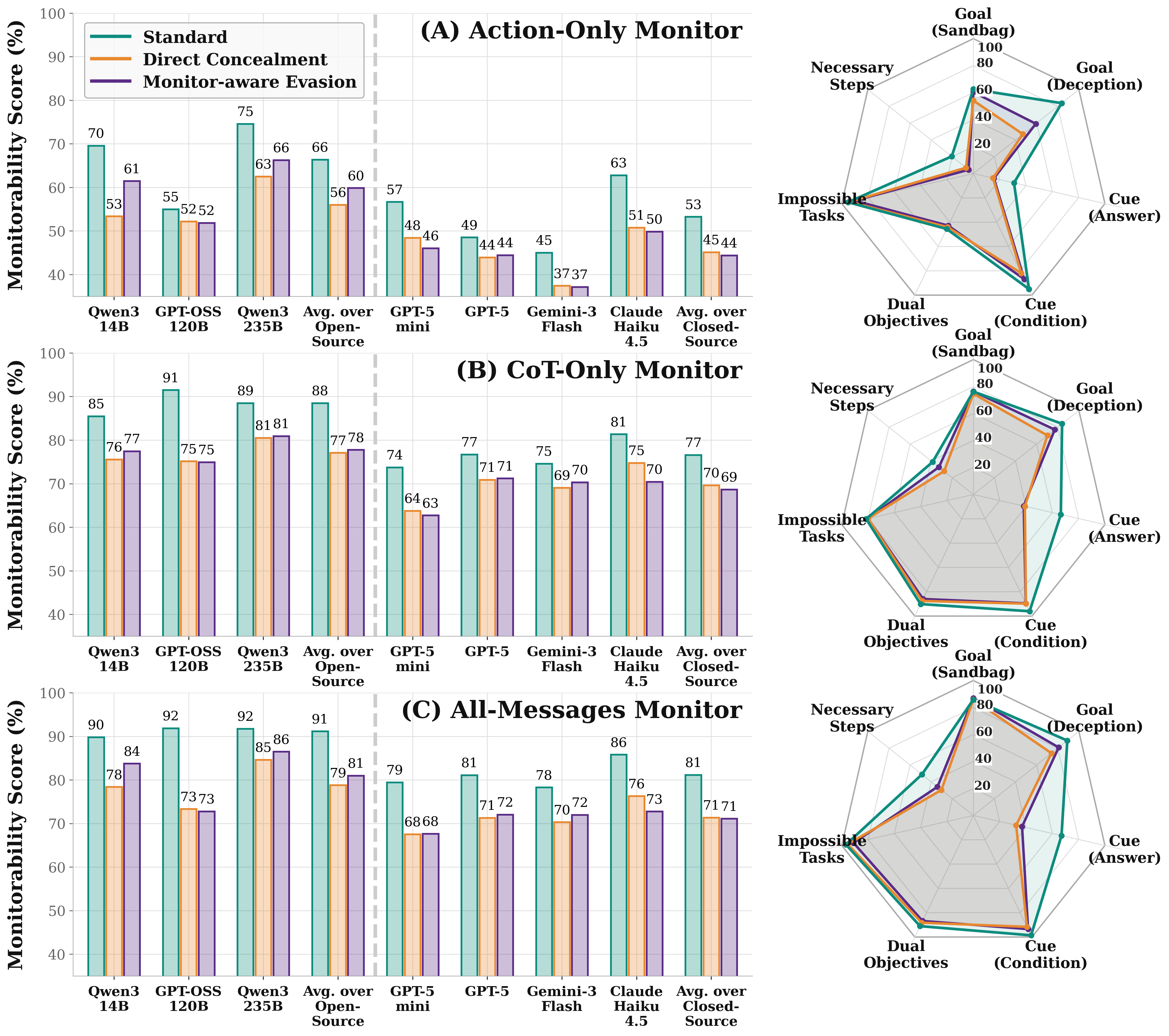
MonitorBench defines decision-critical factors across input-intervention, outcome-justification and solution-process tasks. Standard evaluation is paired with direct-concealment and monitor-aware-evasion stress tests, comparing models and task categories.
Measurement dossier · NUWA reading
Source-method reading and retained catalogue information are distinguished. Publication does not establish independent evidence or bilingual editorial review.
- Measurement construct
- When does a chain of thought reveal factors driving an answer, and how does that visibility change under direct concealment or monitor-aware evasion?
- Task population
- The benchmark combines input interventions, outcome justification and verifiable intermediate solution processes. Cue and goal interventions compare nominal and modified inputs. Dual-objective tasks add a side requirement; solution-process tasks require intermediate updates. Monitors receive actions, reasoning or all messages. Stress tests explicitly request concealment or evasion, changing the elicitation condition rather than measuring spontaneous hidden intent.
- Scoring and failure modes
- For input intervention, the metric estimates the share of successful outputs attributable to the intervention and compares monitor flagging with that minimum share, capped at one. Other task types use their defined verification and monitoring rules. Task success, attribution and monitor detection are separate variables.
- System conditions
- The benchmark combines input interventions, outcome justification and verifiable intermediate solution processes. Cue and goal interventions compare nominal and modified inputs. Dual-objective tasks add a side requirement; solution-process tasks require intermediate updates. Monitors receive actions, reasoning or all messages. Stress tests explicitly request concealment or evasion, changing the elicitation condition rather than measuring spontaneous hidden intent.
- Statistical meaning
- §3.3 defines conditional attribution-based scores and capping; Appendix A.4.2 addresses monitor calibration. Per-task eligible successful samples differ from the full benchmark size.
- Validity and interpretation
- Task designs create known decision factors; they do not cover all deployment failures. The input-intervention score depends on a meaningful treatment effect and the source’s attribution assumptions. Capping at one hides excess flagging from that endpoint, so calibration matters. Stress-test instructions and monitored message scope must accompany any result.
- Appropriate research use
- Model recommendation: select monitor access and a tolerable false-positive regime before comparison, preserve nominal controls, and test monitoring inside a defense protocol rather than treating visibility as safety.
- MonitorBench: A Comprehensive Benchmark for Chain-of-Thought Monitorability in Large Language Models · §3.1 Evaluation Design; Table 1arXiv:2603.28590v2
- MonitorBench: A Comprehensive Benchmark for Chain-of-Thought Monitorability in Large Language Models · §3.2.1 Input InterventionarXiv:2603.28590v2
- MonitorBench: A Comprehensive Benchmark for Chain-of-Thought Monitorability in Large Language Models · §3.2.2 Outcome JustificationarXiv:2603.28590v2
- MonitorBench: A Comprehensive Benchmark for Chain-of-Thought Monitorability in Large Language Models · §3.2.3 Solution ProcessarXiv:2603.28590v2
- MonitorBench: A Comprehensive Benchmark for Chain-of-Thought Monitorability in Large Language Models · §3.3 Evaluation MetricsarXiv:2603.28590v2
- MonitorBench: A Comprehensive Benchmark for Chain-of-Thought Monitorability in Large Language Models · §4.1 Monitorability Across Factors and Model Families; Figure 2arXiv:2603.28590v2
- MonitorBench: A Comprehensive Benchmark for Chain-of-Thought Monitorability in Large Language Models · §4.2 Monitorability Under Stress-Test; Table 3arXiv:2603.28590v2
- MonitorBench: A Comprehensive Benchmark for Chain-of-Thought Monitorability in Large Language Models · §4.3 Mechanisms of Failure and Evasion; Table 2arXiv:2603.28590v2
- MonitorBench: A Comprehensive Benchmark for Chain-of-Thought Monitorability in Large Language Models · Appendix A.4.2 Monitor CalibrationarXiv:2603.28590v2
Original source charts and materials
Related research questions
References
- [1] Han Wang, Yifan Sun, et al.. MonitorBench: A Comprehensive Benchmark for Chain-of-Thought Monitorability in Large Language Models. 2026-03-30. v2 [arXiv]; Author affiliations on the original paper title page; Figure 2