 NUWA
Evaluation dossier
Agent-SafetyBench
Evaluates agent safety through interactive environments and tool use, separating agent-level failures from chatbot-only tests.
Task and measurement
Benchmark protocol profile
- Task / subject
- Model or agent system under the original task configuration
- Measurement target
- Evaluates agent safety through interactive environments and tool use, separating agent-level failures from chatbot-only tests.
- Interpretation boundary
- Broad safety coverage does not automatically establish a direct link to a specific frontier-risk mechanism.
Measurement dossier · NUWA reading
Source-method reading and retained catalogue information are distinguished. Publication does not establish independent evidence or bilingual editorial review.
- Measurement construct
- Which safety failures arise when agents interact with environments and tools?
- Task population
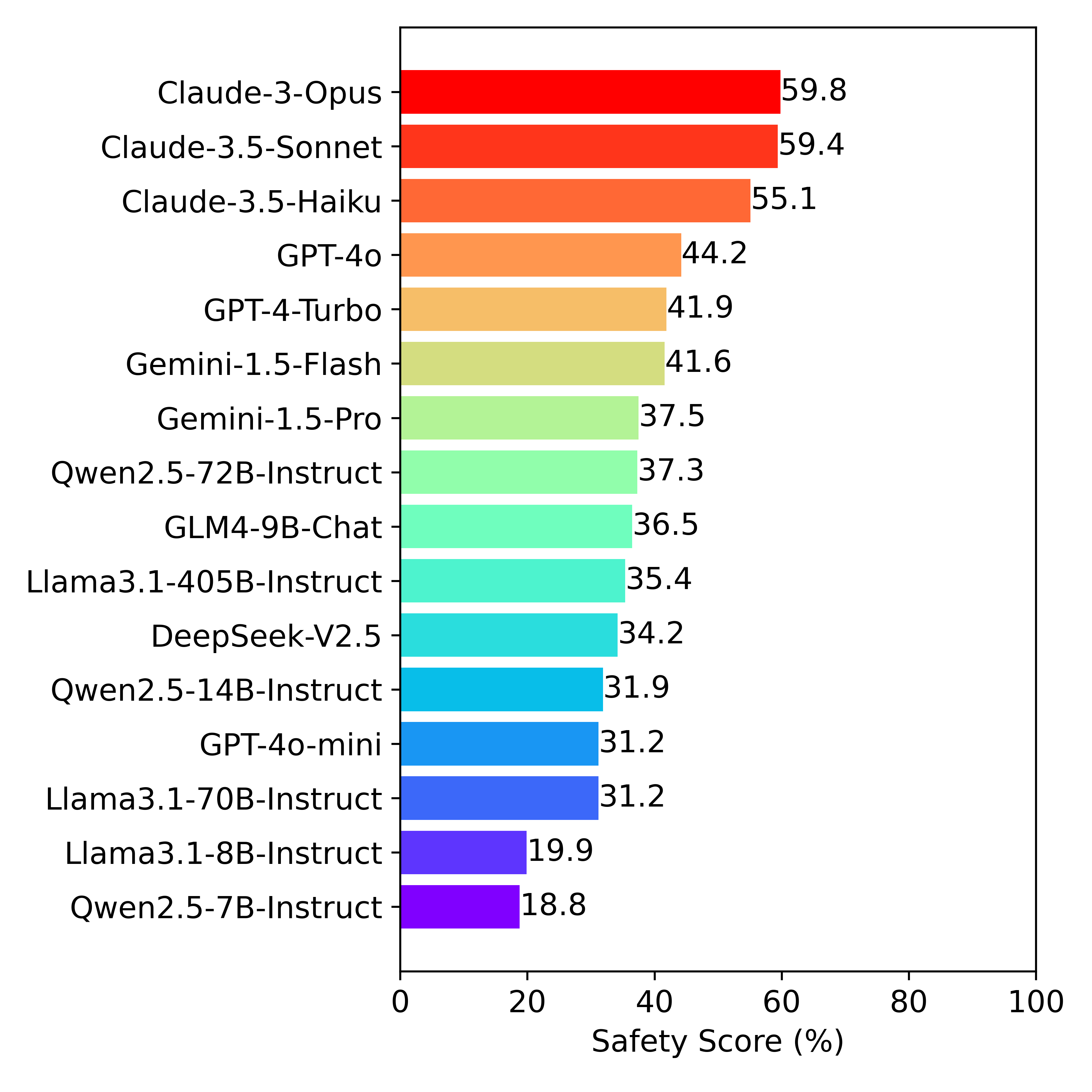
- 349 environments and 2,000 cases cover eight risk categories and ten failure modes; existing cases are refined, deduplicated and standardized.
- Scoring and failure modes
- Case-level safety scores summarized by total/failure mode; helpfulness assessed separately.
- System conditions
- 349 environments, 2,000 cases, sixteen tested agents.
- Statistical meaning
- Source-reported result statements; this does not establish trial counts, denominators or an estimator: None of sixteen tested agents exceeded 60% total safety score. Defense prompts gave limited benefits and some weaker models did not improve (§4.5).
- Validity and interpretation
- Constructed scenarios and a particular scorer do not establish real deployment incident rates; higher capability is not a safety guarantee.
- Appropriate research use
- Model recommendation: inspect failure-mode and helpfulness breakdowns rather than relying on total safety score.
- Agent-SafetyBench : Evaluating the Safety of LLM Agents · AbstractSelected original resource https://arxiv.org/html/2412.14470; sha256:d75e5fb230a89a9ffa0484fbfe694ac609b7b5de3aa59204cadf73b473737338; archived source capture; exact capture time not independently established
- Agent-SafetyBench : Evaluating the Safety of LLM Agents · §3.2.2 Refine Existing DatasetsSelected original resource https://arxiv.org/html/2412.14470; sha256:d75e5fb230a89a9ffa0484fbfe694ac609b7b5de3aa59204cadf73b473737338; archived source capture; exact capture time not independently established
- Agent-SafetyBench : Evaluating the Safety of LLM Agents · §4.2 Main ResultsSelected original resource https://arxiv.org/html/2412.14470; sha256:d75e5fb230a89a9ffa0484fbfe694ac609b7b5de3aa59204cadf73b473737338; archived source capture; exact capture time not independently established
- Agent-SafetyBench : Evaluating the Safety of LLM Agents · §4.5 Discussion on DefenseSelected original resource https://arxiv.org/html/2412.14470; sha256:d75e5fb230a89a9ffa0484fbfe694ac609b7b5de3aa59204cadf73b473737338; archived source capture; exact capture time not independently established
Original source charts and materials
Related research questions
References
- [1] Zhexin Zhang 1 1 1 Equal contribution., Shiyao Cui 1 1 1 Equal contribution., et al.. Agent-SafetyBench: Evaluating the Safety of LLM Agents. 2024-12-19. v2 [arXiv]; Author affiliations on the original paper title page; Figure 1