 NUWA
Evaluation dossier
RE-Bench
Research engineering performance under time budgets.
Task and measurement
Benchmark protocol profile
- Task / subject
- AI agent performing ML research engineering tasks
- Measurement target
- ML research engineering outcomes relative to human experts.
- Interpretation boundary
- AI R&D performance is an enabling capability, not evidence of harmful self-improvement.
Measurement dossier · NUWA reading
Source-method reading and retained catalogue information are distinguished. Publication does not establish independent evidence or bilingual editorial review.
- Measurement construct
- How do agents compare with experts on open-ended ML research engineering?
- Task population
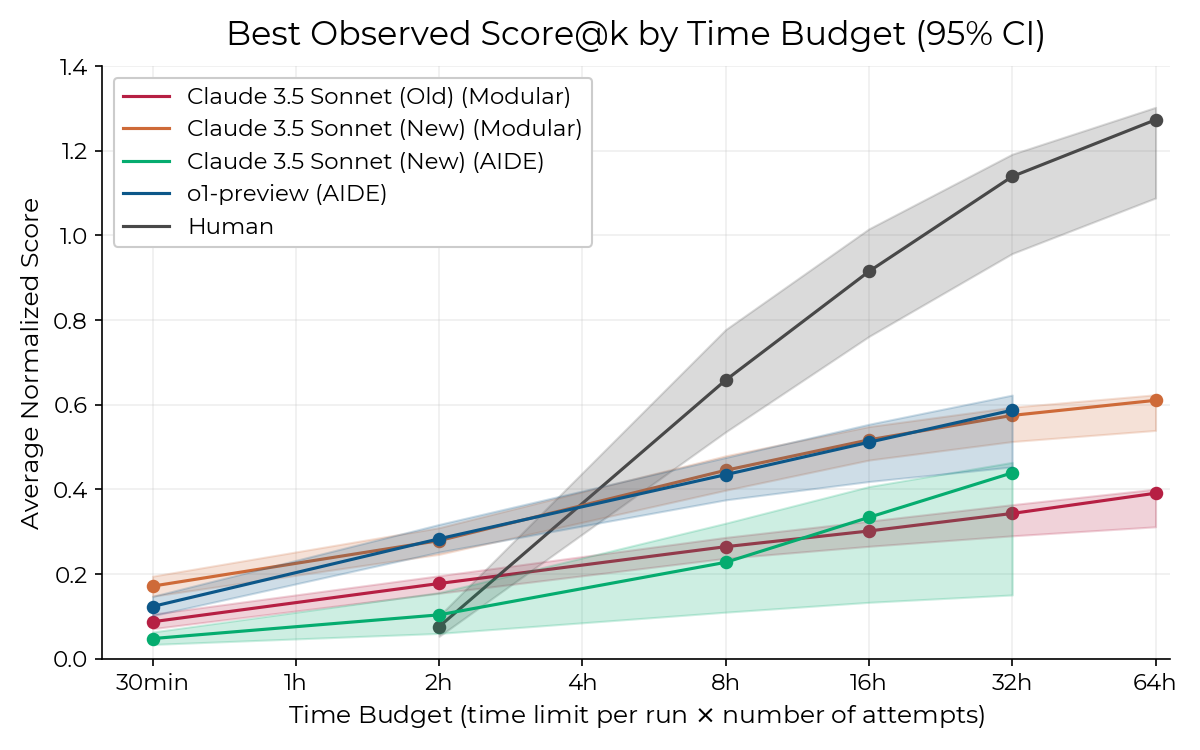
- Seven environments include 71 eight-hour attempts by 61 distinct experts; agent comparisons vary total time, scaffold and best-of-k selection.
- Scoring and failure modes
- Environment-specific normalized research-engineering score; total-time/best-of-k comparisons.
- System conditions
- Seven environments, multiple scaffolds and time budgets; 71 expert eight-hour attempts.
- Statistical meaning
- Source-reported result statements; this does not establish trial counts, denominators or an estimator: 82% of expert attempts earned nonzero scores; 24% matched or exceeded reference solutions. Agents led at two hours, but humans achieved about twice the top-agent score at 32 aggregate hours in the reported setup.
- Validity and interpretation
- Seven environments do not span frontier R&D; limited scaffold iteration could understate agent capability (§6.3).
- Appropriate research use
- Model recommendation: cite normalized score, scaffold, total time and attempt aggregation together.
- RE-Bench: Evaluating frontier AI R&D capabilities of language model agents against human experts · AbstractSelected original resource https://arxiv.org/html/2411.15114v2; sha256:4a4df1346307f7b31e65c6c0e8b5533d0a6649904ea600d5b0d4d893a5d64c58; archived source capture; exact capture time not independently established
- RE-Bench: Evaluating frontier AI R&D capabilities of language model agents against human experts · §3.1 Design goalsSelected original resource https://arxiv.org/html/2411.15114v2; sha256:4a4df1346307f7b31e65c6c0e8b5533d0a6649904ea600d5b0d4d893a5d64c58; archived source capture; exact capture time not independently established
- RE-Bench: Evaluating frontier AI R&D capabilities of language model agents against human experts · §4 Experiments and resultsSelected original resource https://arxiv.org/html/2411.15114v2; sha256:4a4df1346307f7b31e65c6c0e8b5533d0a6649904ea600d5b0d4d893a5d64c58; archived source capture; exact capture time not independently established
- RE-Bench: Evaluating frontier AI R&D capabilities of language model agents against human experts · §6.3 Other LimitationsSelected original resource https://arxiv.org/html/2411.15114v2; sha256:4a4df1346307f7b31e65c6c0e8b5533d0a6649904ea600d5b0d4d893a5d64c58; archived source capture; exact capture time not independently established
Original source charts and materials
Related research questions
Autonomy / Sustained autonomous work →
The source measures a prerequisite capability; it does not show the risk behavior.
References
- [1] Hjalmar Wijk, Tao Lin, et al.. RE-Bench: Evaluating frontier AI R&D capabilities of language model agents against human experts. 2025-05-27. v2 [arXiv]; Author affiliations on the original paper title page; Figure 2