 NUWA
Risk Evaluation · Benchmark
Task-Completion Time Horizons of Frontier AI Models
NUWA research note · independent review pending
NUWA Research Note
Research questionDesign and assumptionsSource findingsNUWA interpretationLimits and contrary evidenceResearch connectionsResearch and decision relevanceEvidence updateInstitutions and rolesOriginal resourcesModel-assisted reading · Selected sections of the original full text or official article; a complete section-by-section audit remains pending.
At a glance
Time horizon connects task success to the time a human expert needs for a task. It is a fitted property of a task distribution, not a stopwatch on an autonomous agent.
Research question
How does the difficulty of software tasks an agent can complete change across model releases when difficulty is calibrated by successful human completion time?
Design and assumptions
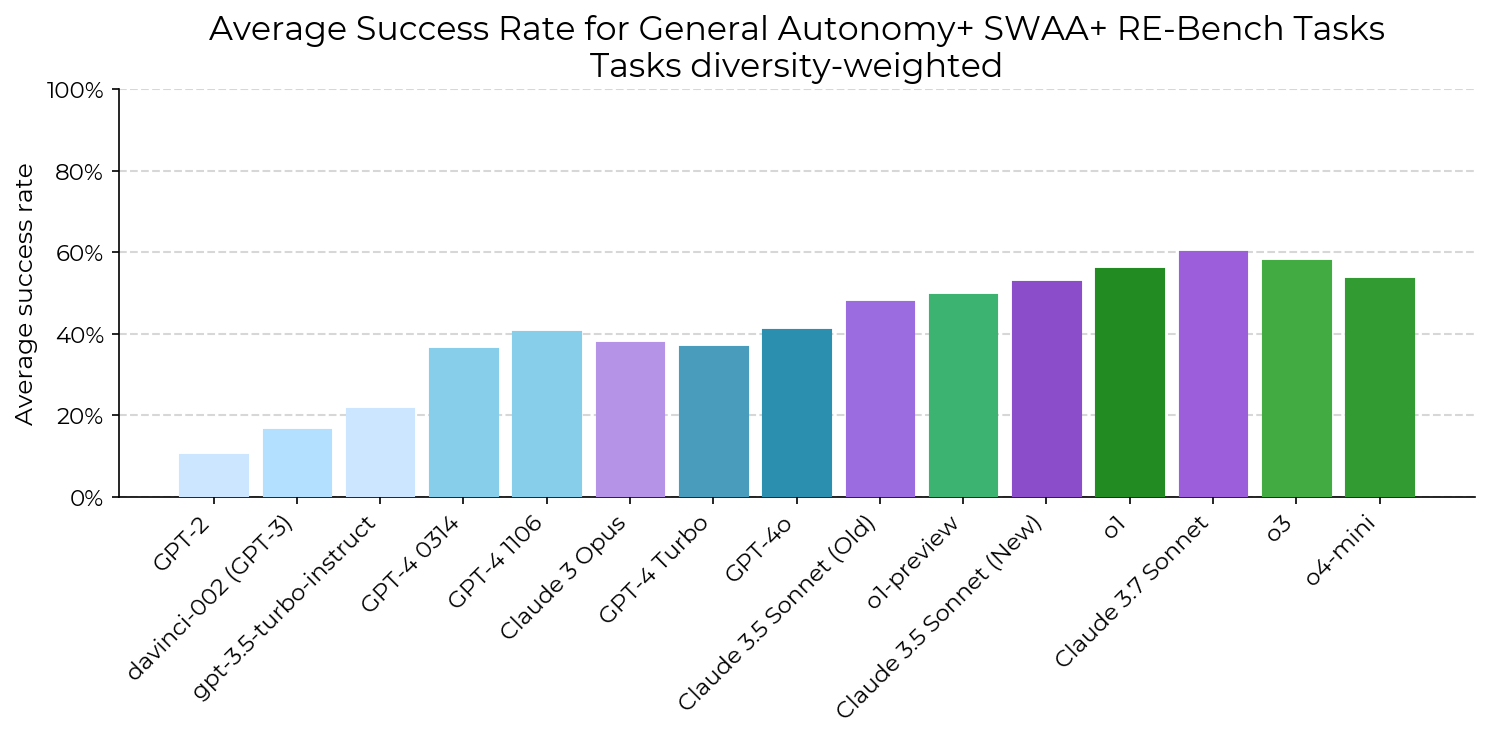
The paper combines HCAST software tasks, RE-Bench research engineering tasks and short software atomic actions. Human baselines establish task durations, with researcher estimates for some tasks. Continuous scores are converted to task-specific binary success thresholds. A logistic model relates success to log human time; its midpoint defines the 50% horizon. Family weighting prevents large task families dominating the fit.
Source findings
The paper finds a strong relation between human task duration and agent success, and increasing estimated horizons across the examined releases (§§2.3–3).
Robustness checks include retrodiction, SWE-bench Verified, task messiness and internal pull requests. Messier tasks reduce absolute performance; human context changes the duration baseline (§4).
Table 1 includes a JSON transformation task inferred from input/output examples. Its automatic check illustrates the suite’s measurable endpoints while also showing the constraint imposed by machine scoring.
NUWA interpretation
A longer horizon supports greater capability on this software distribution. It does not by itself demonstrate sustained autonomy, replication, willingness to resist intervention or a particular economic impact. The source’s extrapolations remain conditional on trend continuation and generalization.
Limits and contrary evidence
Task durations depend on skill and context; internal maintainers and contractors can take very different times. Automatically scored, mostly static tasks omit many resource constraints, interactions and costly mistakes. Continuous-score thresholds and family weighting are modeling choices. The original paper and live 1.1 dashboard must not be silently treated as one unchanged suite.
Research connections
RE-Bench contributes tasks and human baselines to the measurement design (§2.1). RepliBench and shutdown resistance examine distinct requirements and behaviors; connecting them to this horizon requires a new same-system evidence argument, not score averaging.
Research and decision relevance
Model recommendation: use horizons to select task difficulty and desired reliability, attach the exact suite version and interval, and request separate evidence for intervention response.
Precise source locations
- Measuring AI Ability to Complete Long Software Tasks · §2.1 Task suite / dataset; Table 1arXiv:2503.14499v4 (2026-10-25 capture)
- Measuring AI Ability to Complete Long Software Tasks · §2.2 BaseliningarXiv:2503.14499v4 (2026-10-25 capture)
- Measuring AI Ability to Complete Long Software Tasks · §3.1 Computing time horizon; Figure 4arXiv:2503.14499v4 (2026-10-25 capture)
- Measuring AI Ability to Complete Long Software Tasks · §4 External validity and robustnessarXiv:2503.14499v4 (2026-10-25 capture)
- Measuring AI Ability to Complete Long Software Tasks · §6 Discussion; Appendix B.2; Appendix E.3arXiv:2503.14499v4 (2026-10-25 capture)
Source checking, extraction, editorial approval and replication are recorded separately. Methodology →
Evidence update · 2026-10-28
Model-assisted reading · independent evidence and bilingual editorial review pending. Values are source findings or inventory counts, separate from the trend result series.
Read horizon estimates with their fit version, task-suite saturation and human-duration measurement. A methodological revision is not a capability regression; a horizon does not directly measure research speedup or continuous autonomous runtime.
Related reading
NUWA reading connections; these do not imply citation, replication or score equivalence.
Sources for this interpretation
- Impact of modeling assumptions on time horizon results · Summary; model correction; uncertainty table; text lines 00043,00069,00240Original resource captured 2026-10-28T07:24:45.348612+00:00; sha256:9695043f6347be4a67091843e5b34b1db63f1ab11ee6a7956edcf1094182bd20
- Clarifying limitations of time horizon · Research note and limitations; text lines 00072Original resource captured 2026-10-28T07:24:45.640517+00:00; sha256:caec62e207534efe7e6fbcb55bb6a12459264f8591145eef7d9cac011c571860
Institutions and roles



Authors (26)
Thomas Kwa · Ben West · Joel Becker · Amy Deng · Katharyn Garcia · Max Hasin · Sami Jawhar · Megan Kinniment · Nate Rush · Sydney Von Arx · Ryan Bloom · Thomas Broadley · Haoxing Du · Brian Goodrich · Nikola Jurkovic · Luke Harold Miles · Seraphina Nix · Tao Lin · Chris Painter · Neev Parikh · David Rein · Lucas Jun Koba Sato · Hjalmar Wijk · Daniel M. Ziegler · Elizabeth Barnes · Lawrence Chan
Evaluation protocols
Cite and reuse
Cite the original publication for its findings. Cite this NUWA record separately for its explanation and retained snapshot.
Original publication · BibTeX
@misc{time-horizons,
  title = {Task-Completion Time Horizons of Frontier AI Models},
  url = {https://metr.org/time-horizons/},
  author = {Thomas Kwa and Ben West and Joel Becker and Amy Deng and Katharyn Garcia and Max Hasin and Sami Jawhar and Megan Kinniment and Nate Rush and Sydney Von Arx and Ryan Bloom and Thomas Broadley and Haoxing Du and Brian Goodrich and Nikola Jurkovic and Luke Harold Miles and Seraphina Nix and Tao Lin and Chris Painter and Neev Parikh and David Rein and Lucas Jun Koba Sato and Hjalmar Wijk and Daniel M. Ziegler and Elizabeth Barnes and Lawrence Chan},
  year = {2026},
  date = {2026-09-08},
  version = {Time Horizon 1.1; page updated 2026-09-08},
  note = {Time Horizon 1.1; page updated 2026-09-08}
}
NUWA record · BibTeX
@misc{time-horizons-nuwa,
  title = {Task-Completion Time Horizons of Frontier AI Models — NUWA research record},
  url = {https://whitzard.tech/en/nuwa/whitzard-index/work/time-horizons/},
  version = {2026-10-29.1},
  organization = {NUWA Frontier AI Safety Lab},
  howpublished = {Retained note edition: https://whitzard.tech/nuwa/whitzard-index/data/record-editions/2026-10-29.1--time-horizons.json},
  note = {NUWA research note. Source-reading scope and independent review status are stated on the record. Snapshot 2026-10-29.1. Retained note edition: https://whitzard.tech/nuwa/whitzard-index/data/record-editions/2026-10-29.1--time-horizons.json.}
}
Evidence snapshot 2026-10-29.1 · Index updates · RSS
References
- [1] Thomas Kwa, Ben West, et al.. Task-Completion Time Horizons of Frontier AI Models. 2026-09-08 ; Retained existing source-specific note sections; this pass audits duplicate/boilerplate structure and source availability, not complete section-level verification.
- [2] Thomas Kwa, Ben West, et al.. Measuring AI Ability to Complete Long Software Tasks ; Author affiliations on the original paper title page; §2.1 Task suite / dataset; Table 1; §2.2 Baselining